Security Screen Doors: A Buyer’s Guide


Table of Contents
- What Are Security Screen Doors and How They Differ from Standard Screens
- How to Measure for a Security Screen Door
- Material Types and Impact Resistance Ratings
- Heavy-Duty Security Screen Door Options
- Security Screen Door Cost Estimate and Pricing Factors
- Installation: DIY vs. Professional Services
- Maintenance and Long-Term Care
- Frequently Asked Questions
Last Updated: September 29, 2026
What Are Security Screen Doors and How They Differ from Standard Screens
A security screen door is a reinforced entry door that provides protection against forced entry while maintaining visibility and airflow. Unlike standard screens designed mainly to keep insects out, security screen doors combine heavy-duty construction with impact resistance.
Standard screens use lightweight aluminum frames and thin mesh that tear easily. Security screen doors feature all-metal construction with reinforced steel mesh, tamper-proof hinges, and deadbolt-compatible hardware for residential security applications.
Security screen doors keep pests out while allowing fresh air circulation, increase home security with a physical barrier against intrusion, and reduce solar heat gain and UV exposure. Best Custom Screens offers fully assembled security screen doors shipped nationwide, eliminating fitting problems with standard alternatives.
A standard screen suits a guest bedroom window, but a security screen door at your main entry must withstand deliberate force.
How to Measure for a Security Screen Door
Accurate measurements are essential for proper fit. Most installation failures result from measurement errors rather than product quality.
Start by measuring the width of your door opening at three points: top, middle, and bottom. Use the smallest measurement as your width dimension. This accounts for frames that aren’t perfectly square. Next, measure the height at the left edge, center, and right edge. Again, use the smallest value.
Record measurements in inches to the nearest 1/8 inch, as even a quarter-inch discrepancy can cause binding or gaps.
For sliding doors, measure the track opening width and full height from threshold to header. For swinging doors, measure the frame opening where hinges will mount. Note any obstructions like outlets, fixtures, or trim.
When ordering custom security screen doors, Best Custom Screens provides measurement guides that walk you through this process step by step. Their fully assembled approach means your door arrives ready to install with custom sizing already built in, eliminating the most common source of fitting problems.
Material Types and Impact Resistance Ratings
Security screen doors use several material combinations, each affecting durability, maintenance, and forced-entry resistance. Understanding material standards helps you distinguish genuine security products from decorative alternatives.
Steel mesh is the industry standard for security applications. It resists cutting, tearing, and pet damage far better than aluminum mesh. Steel mesh is measured in gauge, lower numbers indicate thicker wire. A 9-gauge or lower is considered heavy-duty; 12-gauge or higher is standard screening. Powder-coated finishes provide rust-resistant protection essential for weathered doors.
Reinforced aluminum frames paired with steel mesh balance weight and strength, with easier installation than solid steel. However, solid steel frames offer superior structural integrity. Frame thickness matters: 1.25 inches or less is standard-duty; 1.5 inches or thicker is heavy-duty construction.
Perforated metal screening provides visibility while maintaining security, working well where aesthetics matter alongside protection.
Understanding Impact Resistance Standards
The American Society for Testing and Materials (ASTM) publishes impact resistance standards. While security screen doors aren’t federally mandated for certification, reputable manufacturers voluntarily test against ASTM F1233 or similar protocols.
Rust-Resistant Finishes and Longevity
Powder-coated finishes outlast painted surfaces and provide UV protection. In coastal or humid environments, this difference extends door life by years. Look for powder-coat thickness specifications (typically 2-3 mils) as a quality marker. Some manufacturers use hot-dip galvanizing or anodizing for extreme environments.
Heavy-Duty Security Screen Door Options
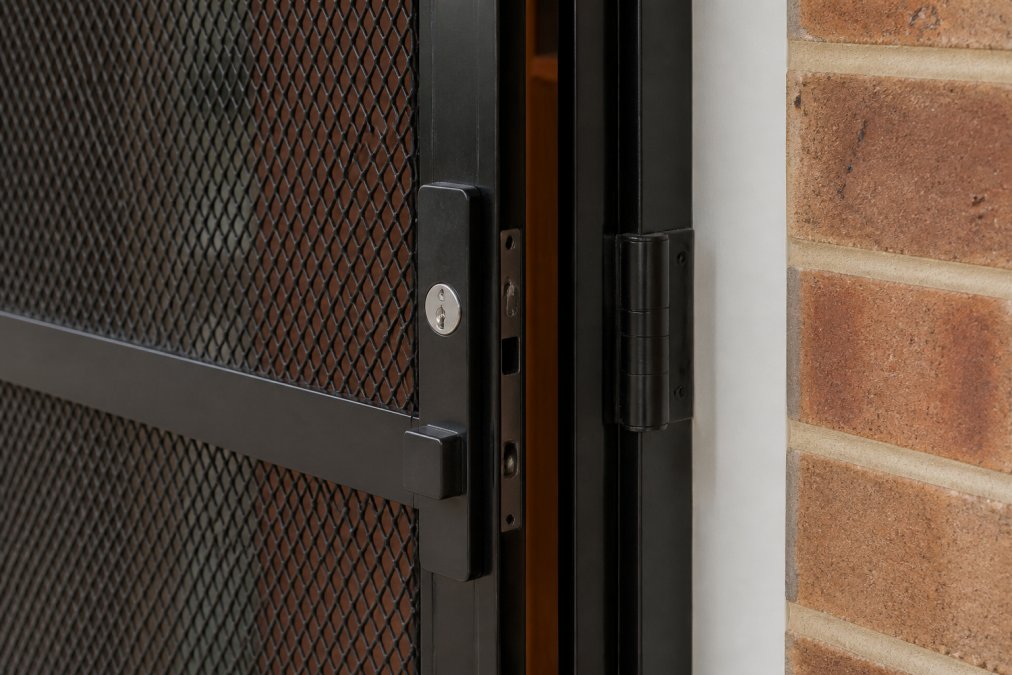
Heavy-duty security screen doors represent the top tier of residential entry protection, combining maximum impact resistance with professional-grade hardware.
Heavy-duty doors use thicker steel frames (typically 1.5 inches or larger), lower-gauge steel mesh, and hinges reinforced with additional bracing to prevent prying.
Custom fabrication fits unusual openings with additional reinforcement at stress points, custom sizing, and integrated security features like reinforced door sweeps and weather stripping.
Best Custom Screens offers heavy-duty options with all-metal construction and professional-grade hardware. These doors arrive fully assembled and ready for installation, combining the durability of custom fabrication with the convenience of pre-built solutions.
Security Screen Door Cost Estimate and Pricing Factors
Several factors influence security screen door pricing, and understanding them helps you make informed decisions about your investment.
Material selection drives the primary cost difference. Steel mesh costs more than aluminum mesh but delivers superior durability and security. Powder-coated finishes cost more than basic paint but last significantly longer. Custom sizing adds cost compared to standard dimensions, but ensures proper fit that prevents problems down the road.
Door type affects pricing considerably. Sliding screen doors typically cost less than swinging security screen doors due to simpler hardware requirements. Prehung doors that arrive fully assembled cost more upfront than component kits but eliminate assembly labor and potential fitment issues. Securing the perimeter involves more than just the door frame, as integrated outdoor security lighting provides a necessary layer of visibility to complement these physical barriers.
Size and complexity matter significantly. Larger openings require more material and stronger structural support. Non-standard shapes, custom colors, or specialty mesh options increase fabrication time and cost. Standard rectangular doors in common sizes represent the most economical choice.
For current pricing on security screen doors, Best Custom Screens provides quote requests based on your specific dimensions and material preferences. Pricing depends on quantity, delivery timeframe, and custom specifications. Their fully assembled approach means you’re paying for precision manufacturing and convenient installation rather than struggling with components that may not fit properly.
Installation: DIY vs. Professional Services
Installation difficulty varies dramatically based on door type, frame condition, and your home’s construction. Understanding the risks and structural requirements helps you decide whether DIY makes sense for your situation.
When DIY Installation Works
DIY installation works best for sliding screen doors in standard-sized openings where the frame is square, undamaged, and properly secured to the house. You’ll need basic tools: a drill, level, screwdriver set, measuring tape, and shims. Most sliding doors install in 30-60 minutes once you understand the process.
Before starting, inspect your frame carefully. Look for:
- Visible damage: Cracks, rot, or warping in the door frame or surrounding trim
- Gaps and alignment: Use a level to check if the frame is plumb (vertical) and square. Place the level against the left edge, top, and right edge. If the bubble doesn’t center in all three positions, the frame is out of square
- Fastener security: Check if the existing frame is securely fastened to the house structure. Loose frames will cause new doors to bind or fail to close properly
- Threshold condition: Inspect the threshold (bottom sill) for rot, damage, or improper slope. Water should drain away from the house, not toward it
If your frame passes these checks, DIY installation is reasonable for sliding doors. The process is forgiving because sliding hardware accommodates minor frame irregularities.
When Professional Installation Is Essential
Swinging security screen doors require precision that most homeowners lack. Hinges must be perfectly aligned or the door binds, swings open uncontrollably, or fails to latch.
- Frame is out of square: If your level test shows the frame deviates more than 1/4 inch over the full height or width, professional shimming and reinforcement are necessary
- Visible frame damage: Cracks, rot, warping, or water damage require repair before installation. Professionals assess whether the frame can be reinforced or must be replaced
- Loose or damaged threshold: A deteriorated threshold cannot support a heavy security door properly. Professionals replace or reinforce thresholds as needed
- Non-standard openings: Arched doorways, offset frames, or unusual dimensions require custom fitting and structural assessment
- Structural concerns: If the door frame is not securely fastened to the house structure, or if the surrounding wall shows signs of settling or damage, professional evaluation prevents costly mistakes
- Heavy-duty or custom doors: Doors with reinforced frames or specialized hardware benefit from professional installation that ensures all components function as designed
Understanding the Cost-Risk Trade-Off
What Professional Installation Includes
When you hire a professional, expect the service to include:
- Frame inspection and assessment of structural condition
- Shimming and reinforcement if needed to achieve plumb and square alignment
- Proper hinge installation with all fasteners secured to solid structure
- Threshold installation or repair to ensure proper drainage and support
- Testing of the door’s operation, latch engagement, and locking mechanism
- Weather stripping installation to seal gaps and improve energy efficiency
Maintenance and Long-Term Care
Security screen doors require regular maintenance to preserve their security function and appearance over time. Neglected doors deteriorate faster and lose their protective qualities.
Frequently Asked Questions
What’s the difference between a security screen door and a standard screen door?
Standard screen doors use lightweight aluminum frames and thin mesh designed primarily to keep insects out while allowing airflow. Security screen doors feature reinforced steel or heavy-gauge aluminum frames, tamper-proof hinges, impact-resistant mesh, and deadbolt-compatible locking systems. The structural integrity of a security screen door makes it resistant to forced entry and physical damage, while standard screens offer minimal protection against intentional breach or pet damage. Security doors also use thicker, more durable mesh materials like steel mesh or perforated metal that won’t tear easily.
How much should it cost to install a security screen door?
Installation costs depend on whether you choose DIY assembly or professional fitting. Fully assembled security screen doors are designed for homeowner installation without special tools, typically requiring just basic hand tools and taking 30 minutes to an hour. For accurate pricing on products, contact Best Custom Screens for a quote tailored to your specific door dimensions and requirements.
Are custom-made security screen doors worth the investment?
Custom security screen doors offer precision fit for odd-sized openings, superior durability compared to big-box alternatives, and the ability to specify exact materials and features like pet-resistant mesh or solar screening. They arrive fully assembled and ready to install, saving time and frustration. While pricing depends on customization and delivery, the investment pays dividends through longer lifespan, better security ratings, and elimination of gaps that allow pests or intruders to exploit poorly fitted standard doors. For homeowners with non-standard openings or specific security and durability needs, custom fabrication delivers value that generic options cannot match.
What materials offer the best protection in a security screen door?
Steel mesh and reinforced aluminum provide the strongest impact resistance and tamper-proof performance. Steel mesh offers superior puncture resistance against forced entry and pet damage, while powder-coated finishes prevent rust and corrosion. Hinged security doors with dual-bore deadbolt compatibility and reinforced door frames provide structural integrity that resists prying. Look for doors with security ratings that meet or exceed industry standards for impact resistance. The frame material, mesh gauge, hinge quality, and locking system all contribute to overall protection; heavy-duty options combine all these elements for maximum durability and security.