Garage Screen Door: Installation, Maintenance & Selection Guide


Table of Contents
- What a Garage Screen Door Does for Your Home
- How to Measure for a Screen Door
- Heavy-Duty Screen Door Materials That Last
- Types of Garage Screen Systems
- Installation: DIY vs Professional Setup
- Sliding Screen Door Adjustment Guide
- Energy Efficiency, Security, and Long-Term Value
- Frequently Asked Questions
Last Updated: October 2, 2026
What a Garage Screen Door Does for Your Home
A garage screen door is a retractable or sliding barrier that fits your garage opening, allowing fresh air and natural light while keeping insects, pests, and debris out. Unlike standard garage doors, a screen door maintains ventilation and visibility without the weight, noise, or energy consumption of a full overhead door.
A garage screen door transforms your garage into a multi-purpose space: work on projects in fresh air, let pets move freely between indoors and outdoors, and reduce air conditioning reliance during mild weather.
A properly fitted garage screen door makes the difference obvious within the first week: no gaps where insects sneak through, no sagging or misalignment, no wrestling with installation hardware.
Heavy-duty materials matter: a fiberglass mesh with PVC-coated polyester frame withstands daily wear, pet claws, and temperature swings for years.
How to Measure for a Screen Door
Taking accurate measurements
Accurate measurements are essential. A garage screen door that doesn’t fit won’t seal properly, allowing insects inside.
Measure width at three points (top, middle, bottom) and use the smallest measurement as your reference, since garage frames aren’t always perfectly square.
Measure height at three points (left, center, right) to ensure smooth operation without binding or dragging.
For sliding doors, measure frame depth to determine correct mounting hardware.
Record all measurements and photograph them for reference.
Common measurement mistakes to avoid
The biggest mistake is measuring only once. Garage frames settle and shift; a half-inch difference between top and middle measurements matters for proper fit.
Measure the inside of the frame, not the outside, since the screen door sits inside the opening.
Account for existing trim, molding, or weather stripping by subtracting from measurements.
Account for operational clearance: retractable doors need space above the opening to roll up; sliding doors need side clearance for the track.
Heavy-Duty Screen Door Materials That Last
Mesh types and durability
Fiberglass mesh is the standard for residential garage screen doors, lightweight, affordable, and sufficient for normal use.
Pet-resistant mesh survives claws and constant contact, with slightly reduced visibility and airflow, a worthwhile trade-off for pet owners.
Aluminum mesh is heavier and more durable but reduces visibility; it’s typically reserved for commercial or extreme-weather use.
PVC-coated polyester extends lifespan from five to ten years by protecting against UV degradation, moisture, and temperature swings, especially valuable in intense sun or humid climates.
Mesh weave affects ventilation and solar heat gain: tighter weave blocks more heat but reduces airflow; looser weave maximizes ventilation but offers less solar protection.
Frame construction options
Aluminum frames are the standard for residential screen doors, lightweight, rust-resistant, and durable against moisture and temperature changes.
Steel frames are heavier but stronger, providing more rigidity and wind resistance for large openings or windy regions.
Vinyl frames are cheaper but warp in heat and become brittle in cold, a false economy for seasonal temperature swings.
Welded joints are stronger than screwed connections and maintain shape longer, evaluate frame assembly, not just material.
Types of Garage Screen Systems
Retractable systems
A retractable garage screen door rolls up into a cassette above the opening, completely clearing the space when open.
The advantage is simplicity, just raise and lower. Works well with unobstructed openings and clearance above for the cassette.
Motorized retractable systems add convenience with button or remote control operation, saving time with frequent use.
The cassette takes up vertical space above the opening and adds mechanical complexity, creating more potential for wear or misalignment.
Sliding screen doors
A sliding garage screen door hangs on a track and slides horizontally, staying in place whether open or closed.
Sliding systems are mechanically simple and reliable, working in almost any configuration including low ceilings.
A sliding door occupies horizontal space when open, which may be inconvenient in narrow garages or with frequent large item movement.
Sliding systems require periodic track cleaning and lubrication to maintain smooth operation and prevent binding.
Roll-down and motorized options
Roll-down garage screen doors operate like a window shade, hanging from a roller mechanism and working in tight spaces.
Motorized roll-down systems offer button or remote control, useful for frequent garage access.
Motorized systems cost more and require electrical installation; motor failure requires professional repair.
Roll-down systems have reduced visibility when partially open due to angled mesh viewing.
Installation: DIY vs Professional Setup
Tool-free installation for DIY homeowners
The best garage screen door for DIY installation arrives fully assembled with all hardware included and pre-mounted.
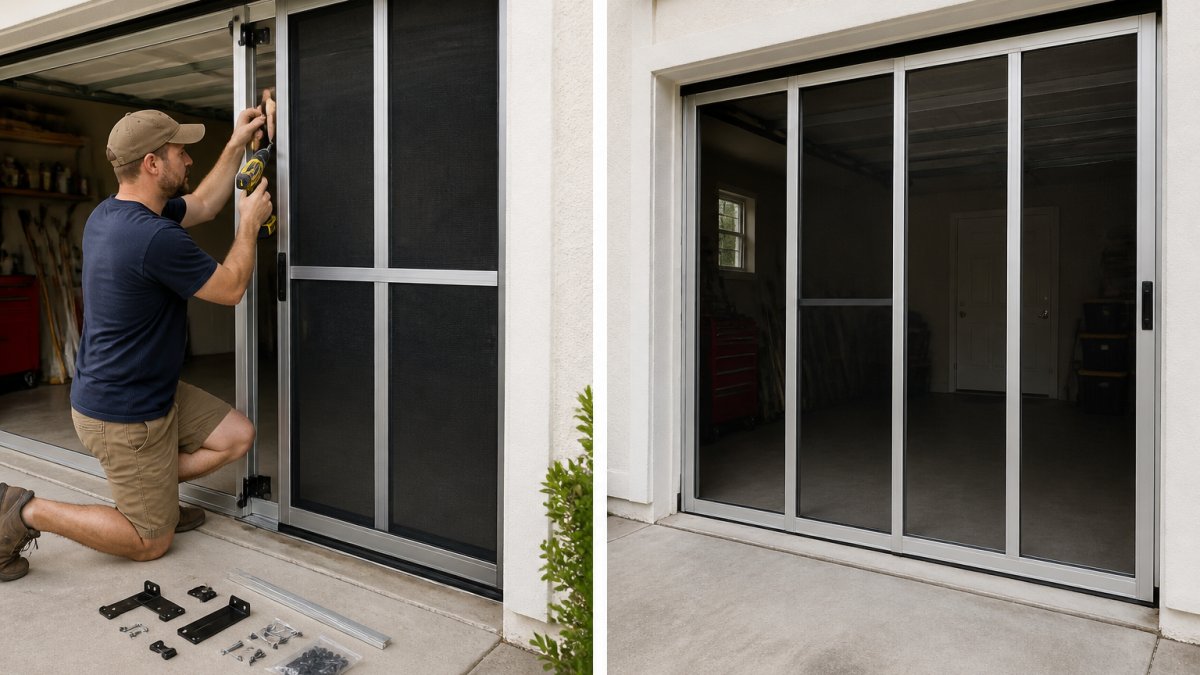
Best Custom Screens ships fully assembled doors ready to install in 30 to 60 minutes, just mount brackets and hang the door.
Tool-free installation requires only a drill or screwdriver to fasten brackets; the door arrives square and stays square.
Fully assembled doors eliminate common DIY mistakes like misaligned frames, sagging, and uneven mesh tension.
When to hire a professional
Professional installation is worthwhile for unusual dimensions, structural issues, out-of-square frames, or existing damage.
Also consider professional installation if you’re uncomfortable with tools or drilling into your garage structure.
For motorized systems, professional installation is often necessary. Running electrical wiring to your garage opening, installing the motor, and programming the controls require skills beyond basic DIY.
The trade-off is cost and scheduling. Professional installation takes time to arrange and adds expense to the project.
Sliding Screen Door Adjustment Guide
Alignment and track maintenance
A sliding garage screen door operates on tracks that must be clean and level.
Clean the tracks every few months. Use a vacuum with a crevice attachment to remove loose debris, then wipe the track with a damp cloth.
Check that the track is level using a spirit level. If the track has shifted or settled, the door will roll toward the low side.
The rollers at the bottom of the door also need attention. They can accumulate dust and debris, which increases friction and makes the door harder to operate.
Troubleshooting common issues
If your sliding garage screen door binds or sticks, the first step is to check the track. Clean it thoroughly and ensure it’s level.
If the door sags or hangs unevenly, the frame or mounting brackets might have shifted.
If the door won’t stay open or closed, the rollers might be worn or the track might be sloped.
If you see gaps between the door and the frame, the door frame might be out of square. This is common in older garages where the structure has settled.
Energy Efficiency, Security, and Long-Term Value
How screens reduce solar heat gain
A garage screen door blocks direct sunlight while allowing air circulation.
The effect is most noticeable in climates with intense sun. This translates to lower cooling costs, especially if your garage is attached to your home and shares walls with living spaces.
The mesh density affects solar blocking. A tighter weave blocks more heat but reduces visibility and airflow. A looser weave maximizes ventilation but offers less thermal protection. The right choice depends on your climate and how you use the space.
Security and pest control benefits
A closed garage screen door keeps insects out while the door is open. This is especially valuable if you’re working in the garage during warm months or if you have pets that spend time there.
From a security perspective, a closed screen door creates a visual and physical barrier.
A screen door also prevents unauthorized access to items stored in your garage. Tools, equipment, and vehicles are less vulnerable to theft when there’s a barrier between the opening and the contents.
Hardware maintenance for durability
Lubricate the track and rollers once or twice a year with a light machine oil or silicone spray.
Check fasteners every six months. Vibration from opening and closing can loosen bolts and screws.
Inspect the mesh periodically for tears or damage. Small tears can be patched, but large damage requires mesh replacement.
For retractable systems, the cassette mechanism needs occasional cleaning.
A garage screen door is an investment in comfort, security, and functionality.
| Feature | Benefit | Best For |
|---|---|---|
| Retractable system | Compact, fully clears opening when open | Frequent daily use, limited horizontal space |
| Sliding door | Simple mechanism, works in low ceilings | Standard garage openings, occasional use |
| Motorized option | Hands-free operation, convenient | High-traffic garages, accessibility needs |
| Pet-resistant mesh | Withstands claws and constant contact | Homes with dogs or cats |
| PVC-coated frame | Extended lifespan, UV protection | Hot climates, intense sun exposure |
| Tool-free installation | No assembly required, 30-60 minute setup | DIY homeowners, quick deployment |
Frequently Asked Questions
What are the main benefits of installing a garage screen door?
A garage screen door allows fresh air and ventilation while keeping insects, pests, and debris out of your garage space. It also reduces solar heat gain in warm climates, improves curb appeal, and provides security without blocking visibility. For homes with pets, a durable screen door enables your animals to enjoy the garage area safely while protecting them from outdoor hazards.
How do I measure for a screen door if my garage opening is an unusual size?
Measure the width and height of your garage door opening at three points: top, middle, and bottom. Record the smallest width and height to ensure proper fit. Include the depth of your door frame if you have one. If your opening is irregular or you’re unsure, most custom screen manufacturers, including Best Custom Screens, can work from photos or detailed measurements to create a precision-fit solution that works the first time.
Can heavy-duty screen door materials really withstand pet damage?
Yes, pet-resistant mesh materials like reinforced fiberglass and PVC-coated polyester are specifically engineered to resist claws and teeth. When paired with sturdy metal frames and proper installation, heavy-duty screens can withstand years of pet use without tearing, making them a cost-effective long-term solution for households with dogs or cats.
How hard is it to install a garage screen door myself?
Tool-free installation options make DIY setup straightforward for most homeowners. Fully assembled screens ship ready to install with mounting hardware included. You’ll typically need just a drill and basic hand tools to secure the frame to your garage opening. Most installations take 30 minutes to an hour. If your opening is non-standard or you prefer professional installation, that option is also available.