Can You Install Security Screens on Vinyl Windows?


Table of Contents
- Security Screens for Vinyl Windows: What Actually Works
- Security Screens Without Drilling: Clip, Track, and Tension Systems
- Measuring Windows for Custom Security Screens
- Do Security Screens Block Natural Light?
- Airflow, Visibility, and Pest Protection Compared
- Installation Walkthrough: Step-by-Step for Vinyl Windows
- Frequently Asked Questions
Last Updated: October 12, 2026
Security Screens for Vinyl Windows: What Actually Works
Yes, you can install security screens on vinyl windows, and most homeowners do it without drilling a single hole in the frame. The catch is that vinyl is softer than wood or aluminum, so the mounting method matters more than the screen itself.
Vinyl window frames are the most common window type in modern American homes, and they are also the easiest to damage with the wrong hardware. A screw driven too close to the edge can crack the frame. A heavy screen hung on a weak clip can pull loose over time.
Below, we cover the mounting options that protect your frames, the measuring steps that prevent costly misfits, and the honest trade-offs between security, airflow, and natural light.
The single most important rule for vinyl windows: never drill into the frame unless the manufacturer’s instructions explicitly allow it. Use the existing screen track or a compression-fit system instead.
Why Vinyl Frames Are Different
Vinyl is a hollow, heat-sensitive material, and it behaves nothing like the wood frames it replaced. It expands and contracts with temperature swings, which means a screen that fits snugly in January may rattle in July.
That movement is why hardware choice matters so much. A screw that bites into solid wood stays put. The same screw in vinyl can sit in a hollow channel with almost nothing to grip.
- Vinyl has thinner walls than aluminum or wood
- The material flexes under load, especially on large windows
- Sharp screws create stress points that crack over time
- Existing screen tracks are usually the safest anchor point
Mounting Options That Protect the Frame
Three mounting approaches work reliably on vinyl, and each suits a different situation.
Track-mounted screens slide into the channel your builder already installed. This is the cleanest option because it uses hardware the frame was designed to hold.
Clip-on screens attach with spring clips or friction clips that grip the frame edge. No tools, no holes, and they come off in seconds for cleaning.
Compression-fit screens rely on tension against the frame opening. These work well on windows where you want a removable barrier without any permanent change.
| Mounting Method | Drilling Needed | Best For | Main Trade-Off |
|---|---|---|---|
| Track-mounted | No | Standard vinyl windows with existing channels | Limited to track depth and width |
| Clip-on | No | Renters and quick seasonal swaps | Can loosen on very large openings |
| Compression-fit | No | Odd-sized or older openings | Needs precise measurement |
Each method has a limit. Track systems depend on what your window already has. Clip systems struggle on wide spans. Compression systems demand accuracy, because a screen that is even slightly small will not hold tension.
Security Screens Without Drilling: Clip, Track, and Tension Systems
Security screens without drilling are the standard for vinyl windows, and the reason is simple: drilling voids many window warranties. Most vinyl window makers specify that any penetration of the frame must follow their written instructions, or the warranty on that frame is void.
That single fact reshapes the whole decision. Instead of asking which screws to use, you are asking which non-invasive system fits your window.
- Clip systems use spring steel or friction clips that seat into the frame lip
- Track systems ride in the existing screen channel, just like a standard insect screen
- Tension systems press outward against the frame opening using adjustable springs
The one thing all three share: they spread force across the frame instead of concentrating it at four screw points. That is exactly what vinyl needs.
Skipping the warranty check is the most expensive mistake here. If you drill a vinyl frame and the seal later fails, the manufacturer can deny the claim because the frame was modified outside their instructions.
Measuring Windows for Custom Security Screens
Measuring windows for custom security screens comes down to three numbers per opening: width, height, and depth of the screen channel. Get those right and the screen drops in. Get them wrong and you are shipping it back.
Measure the channel, not the glass. The screen sits in the track, so the track is what determines fit.
Tools and Steps for Accurate Measurements
You need a steel tape measure, a pencil, and a notepad. A laser measure helps on tall windows but is not required.
- Remove the existing screen and set it aside
- Measure the channel width at the top, middle, and bottom
- Record the smallest of the three widths
- Measure the channel height on the left, middle, and right
- Record the smallest of the three heights
- Measure the channel depth with the tape flat against the frame
- Write down the window location for each set of numbers
Taking three readings per dimension catches out-of-square openings, which are common in older homes.
Common Measuring Mistakes to Avoid
A common mistake is measuring the glass opening instead of the screen channel. That produces a screen that is too small and will not seat.
Other frequent errors:
- Measuring only once and assuming the window is square
- Rounding up instead of using the smallest reading
- Mixing up which window each measurement belongs to
- Forgetting to note whether the screen sits inside or outside the track
Label every measurement with the room and window position. It sounds obvious until you are holding six sets of numbers and guessing which belongs to the kitchen.
Do Security Screens Block Natural Light?
Security screens do block some natural light, but far less than most homeowners expect. A standard security mesh typically reduces visible light by roughly a third, while finer insect mesh blocks noticeably less.
The variables that decide how much light you lose:
- Mesh density: tighter weaves block more light and more insects
- Wire diameter: thicker strands cast thicker shadows
- Color and coating: dark mesh absorbs light and reads as darker from inside; light-colored mesh reflects more
- Mesh material: stainless steel and aluminum behave differently at the same density
Here is the part most guides skip. The mesh aperture, meaning the size of each opening in the weave, tells you more about light and airflow than the marketing name on the box. A finer aperture means better pest protection and slightly less daylight. A coarser aperture means more light and air, with larger insects able to pass.
Hold a sample of the mesh up to a window on a sunny day and look through it from inside. Your eye adapts to mesh far faster than a spec sheet suggests, and most people stop noticing the difference within a few minutes of standing in the room.
Security Screens vs. Solar Screens for Glare and Heat
These two products solve different problems, and mixing them up leads to disappointment.
Security screens are built to resist forced entry. Solar screens are built to cut glare and solar heat gain. A solar screen uses a denser shade fabric that blocks a larger share of sunlight, which is why it lowers indoor temperatures but also darkens the room more.
If your goal is home protection, choose security mesh. If your goal is a cooler room and less glare, choose solar. If you want both, some windows can take a security screen while sun-facing windows take solar fabric.
Room-by-Room and Orientation Guidance
Orientation changes the answer. A west-facing window takes the hardest afternoon sun, so a denser mesh there costs you less in perceived brightness because the room was already bright. A north-facing window gets soft, indirect light all day, so a dense mesh there can make the room feel dim.
- South and west facing: denser mesh is usually fine, glare control helps
- North facing: choose a finer, more open weave to keep the room bright
- East facing: morning sun is intense but brief, medium density works well
- Living rooms and kitchens: prioritize light, use open weaves
- Bedrooms: prioritize privacy and pest control, denser mesh is acceptable
Simple Ways to Assess Light Before You Buy
You do not need instruments to judge this. Stand in the room at the time of day you use it most. Hold a mesh sample at arm’s length against the window and look past it, not at it.
Check three things:
- Can you read a book by the light coming through?
- Does the room feel dimmer or just softer?
- Can you still see the view clearly, or does it turn hazy?
Answer those honestly and you will pick the right density the first time.
Airflow, Visibility, and Pest Protection Compared
Airflow through security mesh depends on open area, and open area drops as mesh density rises. A tighter weave keeps out smaller insects but also slows the breeze.
Visibility follows the same curve. Coarser mesh gives clearer outward views. Finer mesh softens the view slightly, though most people adjust within minutes.
| Mesh Type | Light Transmission | Airflow | Pest Protection | Outward View |
|---|---|---|---|---|
| Standard insect mesh | High | High | Good for large insects | Very clear |
| Mid-density security mesh | Moderate | Moderate | Strong | Clear |
| High-density security mesh | Lower | Lower | Strongest | Slightly softened |
| Solar shade fabric | Lowest | Low | Moderate | Softened |
Forced-entry resistance is where security mesh earns its name. The mesh itself is only part of the story. The frame, the locking hardware, and the mounting method all share the load. A strong mesh in a weak frame fails at the frame.
That is why the frame matters as much as the weave. Heavy-duty, all-metal construction holds up where thin extruded frames bend.
Homeowners who want pest protection and forced-entry resistance without darkening the room: mid-density stainless steel mesh in a track-mounted frame.
Installation Walkthrough: Step-by-Step for Vinyl Windows
Installing a security screen on a vinyl window takes about 15 to 30 minutes per window with no special tools.
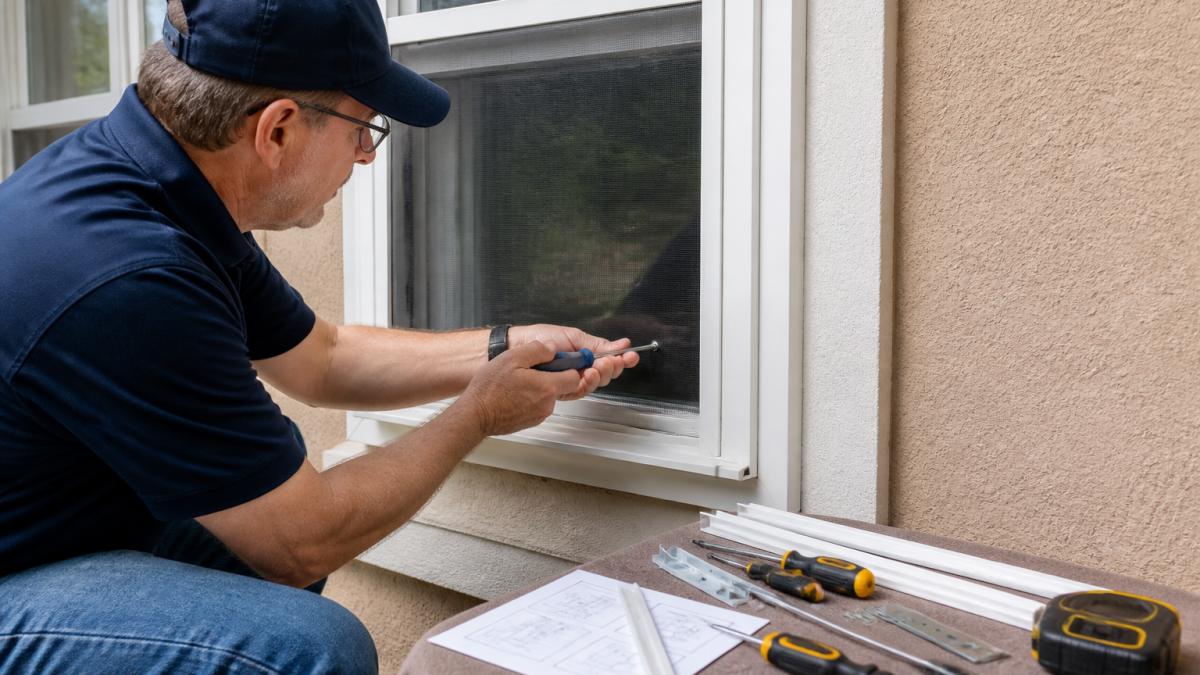
What you’ll need: tape measure, soft cloth, mild soapy water, and a step stool.
- Clean the screen channel with a damp cloth and let it dry
- Check the channel for debris, paint, or bent edges
- Test-fit the screen at a slight angle before seating it
- Lift the screen into the top channel first
- Lower it into the bottom channel and center it
- Slide it side to side to confirm free movement
- Attach any clips or tension springs per the instructions
- Open and close the window to confirm clearance
Expected result: the screen slides smoothly, sits flush in the frame, and does not rattle when the window moves.
If the screen binds, stop. Forcing it can bend the frame or crack the vinyl. Check the channel for debris before trying again.
Vinyl expands in heat, so a screen that fits tightly on a cool morning may drag by afternoon. Leave a small amount of play rather than a press fit.
That is where a custom-made screen beats a big-box size. Best Custom Screens builds each screen to your measurements and ships it ready to install.
Frequently Asked Questions
Can you install security screens on vinyl windows?
Yes, security screens can be installed on vinyl windows. Most systems use brackets or clips that attach to the frame without drilling into the vinyl itself. For a secure fit, choose a screen sized to your exact window dimensions. Custom manufacturers like Best Custom Screens provide fully assembled screens that are ready to install with basic tools.
How do security screens attach to vinyl window frames?
They typically attach with L-brackets, Z-brackets, or tension clips that grip the frame. Some systems use a track that mounts to the sill or sides. No-drill options use adhesive or compression, while more permanent setups use screws into the surrounding wood or masonry, not the vinyl. Always follow the manufacturer’s instructions to avoid damaging the frame.
Do security screens block natural light?
Security screens reduce light by about 20-50%, depending on mesh density, color, and coating. A standard 18×14 stainless steel mesh blocks around 30% of visible light. Darker colors and denser weaves block more, while lighter colors and finer meshes allow more light. Solar screens block more light but also cut glare and heat. For a balance of security and daylight, choose a light-colored, medium-density mesh.
Can security screens be installed without drilling?
Yes, several no-drill options exist. Tension clips, magnetic strips, and adhesive brackets can secure screens to vinyl frames without screws. These work well for renters or for windows where drilling is not desired. However, no-drill mounts may offer less forced-entry resistance than screwed-in brackets. For maximum security, a combination of clips and brackets is recommended.
Vinyl windows and security screens work together when the mounting method respects the frame. The challenge is getting the measurements right and choosing a mesh density that matches each room’s light. Best Custom Screens makes that easier with custom-made screens built to your exact dimensions, heavy-duty all-metal construction options, and fully assembled products that ship ready to install. Submit a request for quote and get screens that fit your vinyl windows the first time.